
How Do Healthy Centenarians Live As Long As They Do.
The key to longevity may be less about " if " we get diseases but rather " when " we get them.

For those looking to live a long, healthy life free of major diseases and with good functional and cognitive capacity…
Healthy centenarians are the group we wish to emulate.
We read their stories in the news, hoping to get a glimpse of how they do it.
Have a positive outlook.
Drink an apple cider vinegar every day.
Cycle everywhere.
The list goes on.
That is how they claim to have kept major diseases and death at bay.
It’s a lovely story and makes for great reading in the newspaper when some lucky soul reaches their 100th birthday.
The problem is, the evidence doesn’t support it.
Consider first how dying itself changed over the last 100 years.
Over the first eight decades of the twentieth century, infectious disease mortality in the United States fell from roughly 797 deaths per 100,000 people to 36.¹
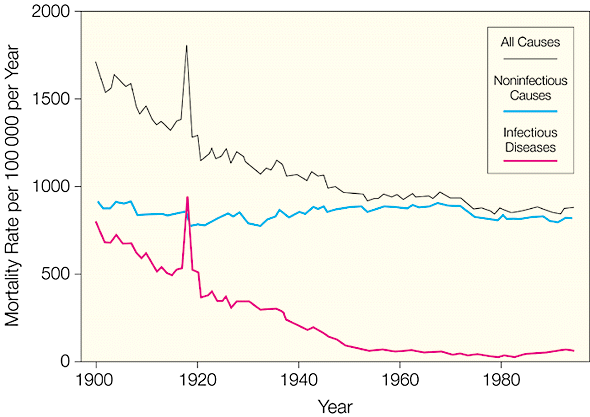
Pneumonia and tuberculosis stopped killing us in the numbers they once did.
But chronic noncommunicable diseases such as heart disease, cancer, and dementia took their place.¹ Epidemiologists call the shift the epidemiologic transition.¹
The problem is that mortality from major chronic diseases has remained relatively stable, and we have not seen the same reductions in early death as we saw with infectious diseases.
We have made incredible progress in treatments for sure, but they have been targeted more at treating the diseases when they occur rather than preventing them in the first place.
Which leaves the interesting question.
If chronic disease still remains as the leading cause of death, what is the pattern seen in healthy centenarians, and how do they achieve the gains in life years that most of us do not?
A Swedish study took everyone born in Sweden between 1920 and 1922, over a quarter of a million people, and followed them from the age of 70.²
Then it compared those who reached 100 against their own birth-cohort peers who didn’t.² No cherry-picked healthy elite. The whole population.
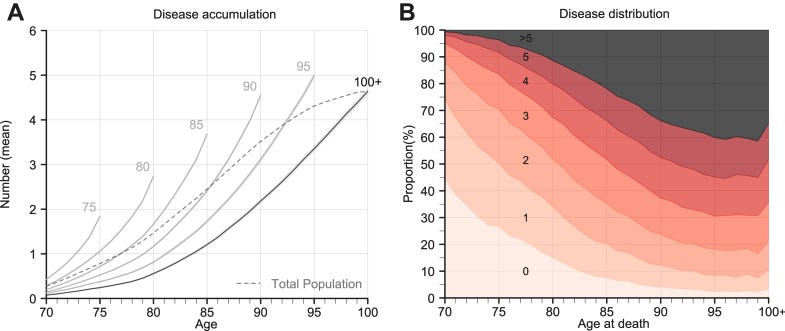
Future centenarians didn’t simply survive through chronic diseases they had far fewer and got them much later in life, at every age measured.²
At 85 the people who would go on to reach 100 had, on average, a little over one diagnosed condition.²
Their peers who would die at 90 carried twice as many.²
The divergence wasn’t a late-life event. It was already there at 70, and the authors think it started earlier than they could see.²
A second line of work pushed further out, to supercentenarians, people past 110, about as close to the ceiling of human life as we can study.³
The pattern stayed the same.
Researchers sorted people three ways:
Survivors, who developed a major age-related disease before 80 and lived on.
Delayers, whose disease came later and
Escapers, who reached 100 with no such disease at all.³
Among 100-year-olds, roughly a third were escapers.³
Among those who touched 110, more than two-thirds were.³
Read that again. The nearer people came to the limit of human life, the more likely they were to have dodged serious disease more or less completely.
Nobody reaches the far edge by being unusually good at surviving heart attacks.
They reach it by pushing the whole disease process so far back that the heart attack never gets its turn.
This sounds like a ridiculous statement to make but it fundamentally means that if we wish to emulate these ‘Escapers’ we need to be as aggresive as possible at managing the risk factors for disease.
Think high blood pressure, high cholesterol, poor metabolic health, smoking, inactivity etc.
In the supercentenarian data, the age at which a quarter of people had developed cardiovascular disease was about 27 years later than in ordinary controls.³
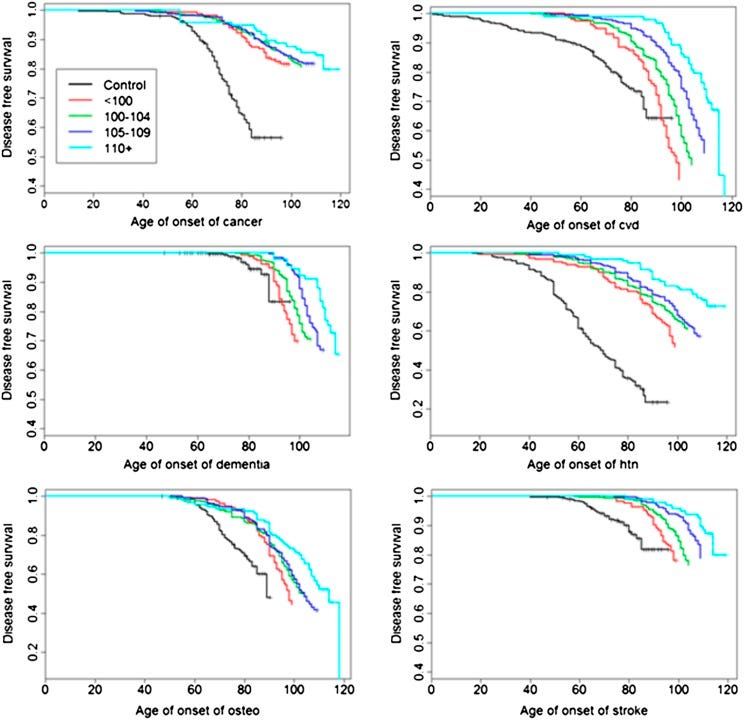
The disease showed up decades behind schedule, when it showed up at all.³
And cardiovascular disease sits dead centre in both studies.
It’s the commonest condition in everyone, centenarians included, yet it takes up far less of their total burden.²
In the Swedish data at age 70, it made up about a quarter of the disease load in future centenarians against more than half in those who died earliest.²
If one thread runs through this whole literature, it is heart disease and when people get it.
Medicine is reactive: the drug, the stent, the surgery.
It is damn good at it but is slowly evolving to include how best to move more people into the ‘Escaper’ category but focusing on risk factors earlier in life.
The longest-lived were rarely rescued. They just got major chronic diseases 10 to 25 years later than everyone else.
We may not have their genetics but at least they have left us a roadmap.
The goal was never to become a person who endures a mountain of illness gracefully.
It was to spend as little of life ill as possible.
Compression of morbidity, the researchers call it, sickness squeezed into a thin band at the very end.³
In the oldest of the old that band gets astonishingly thin. One in ten of the longest-lived stayed essentially free of these diseases until their final three months of life.³
What does this mean for someone reading this at age 50 or even younger?
The biggest point of leverage you have is time.
Time to aggresively manage all of your risk factors.
Waiting is just not a sensible strategy.
Cardiovascular disease, the thing that ends most lives, happens to have the longest silent lead in phase of any of them.
You can measure it and change it for decades before it ever appears.
It means there’s time, and time is the most under utilised tool in prevention.
So drop the picture of the centenarian as a scarred veteran of illness.
The more realistic one is a person who, through some tangle of luck and biology and time, simply met the diseases of age late, and in meeting them late, often skipped them almost entirely.
You don’t get to pick your genes.
You do get to pick when you start paying attention.
The gap between the long-lived and the rest doesn’t open at 90, or even 80.
It opens decades prior when everything still feels fine.
The best time to delay disease is before it starts.
That time is now.

References
Armstrong GL, Conn LA, Pinner RW. tTrends in infectious disease mortality in the United States during the 20th century. JAMA. 1999;281(1):61-66.
Zhang Y, Murata S, Schmidt-Mende K, Ebeling M, Modig K. Disease accumulation and distribution across the lifespan in Swedish centenarians and non-centenarians: a nationwide life course comparison of longevity and health resilience. eClinicalMedicine. 2025;87:103396.
Andersen SL, Sebastiani P, Dworkis DA, Feldman L, Perls TT. Health span approximates life span among many supercentenarians: compression of morbidity at the approximate limit of life span. J Gerontol A Biol Sci Med Sci.2012;67(4):395-405.
The reason “when” behaves the way it does is cumulative exposure. Nobody builds atherosclerosis from the LDL or the blood pressure they’re carrying today.
They build it from cholesterol-years and blood pressure-years, the area under the curve stacking quietly while everything still feels fine.
We count pack-years without blinking. We should be counting these the same way.
Which means a borderline reading isn’t a passing grade. It’s the meter running.
I learned that one the hard way and ended up with a stent at age 44. I evidently didn’t win the gene lottery. Most people don’t.
So how do we get people, and honestly some clinicians too, to stop hearing “borderline” as “recheck next year” and start hearing it as “the silent phase is already underway”?
This is a fascinating article. As a 70 year old who left it very late to listen to Paddy Barrets' advice of prevention always trumping cure, i still feel i have benefitted hugely by taking the tests to find out where I stand and then making an aggressive effort to make positive lifestyle changes and any essential drug interventions. Ill let you know every decade...so far so good!